Micalys Redesign
Micalys Redesign
Micalys Redesign
30% Fewer Redundant Clicks Across the Interface
30% Fewer Redundant Clicks Across the Interface
30% Fewer Redundant Clicks Across the Interface
Redesigning the interface for Micalys to improve workflow efficiency, interface clarity, and system security.
Medical Technology
Medical Technology
Medical Technology
Product Design
Product Design
Product Design
Healthcare Professionals
Healthcare Professionals
Healthcare Professionals
Live Project
Live Project
Live Project
PROBLEM
PROBLEM
The original Micalys interface had usability and security issues that impacted both lab workflows and system integrity. Maintainer Mode is intended for device troubleshooting, is nearly identical to the main diagnostic interface, which created confusion and blurred the line between technical maintenance and clinical use. More critically, it allowed access to sensitive diagnostic slides, raising concerns around data privacy and unauthorised access.
The original Micalys interface had usability and security issues that impacted both lab workflows and system integrity. Maintainer Mode is intended for device troubleshooting, is nearly identical to the main diagnostic interface, which created confusion and blurred the line between technical maintenance and clinical use. More critically, it allowed access to sensitive diagnostic slides, raising concerns around data privacy and unauthorised access.
The original Micalys interface had usability and security issues that impacted both lab workflows and system integrity. Maintainer Mode is intended for device troubleshooting, is nearly identical to the main diagnostic interface, which created confusion and blurred the line between technical maintenance and clinical use. More critically, it allowed access to sensitive diagnostic slides, raising concerns around data privacy and unauthorised access.
SOLUTION
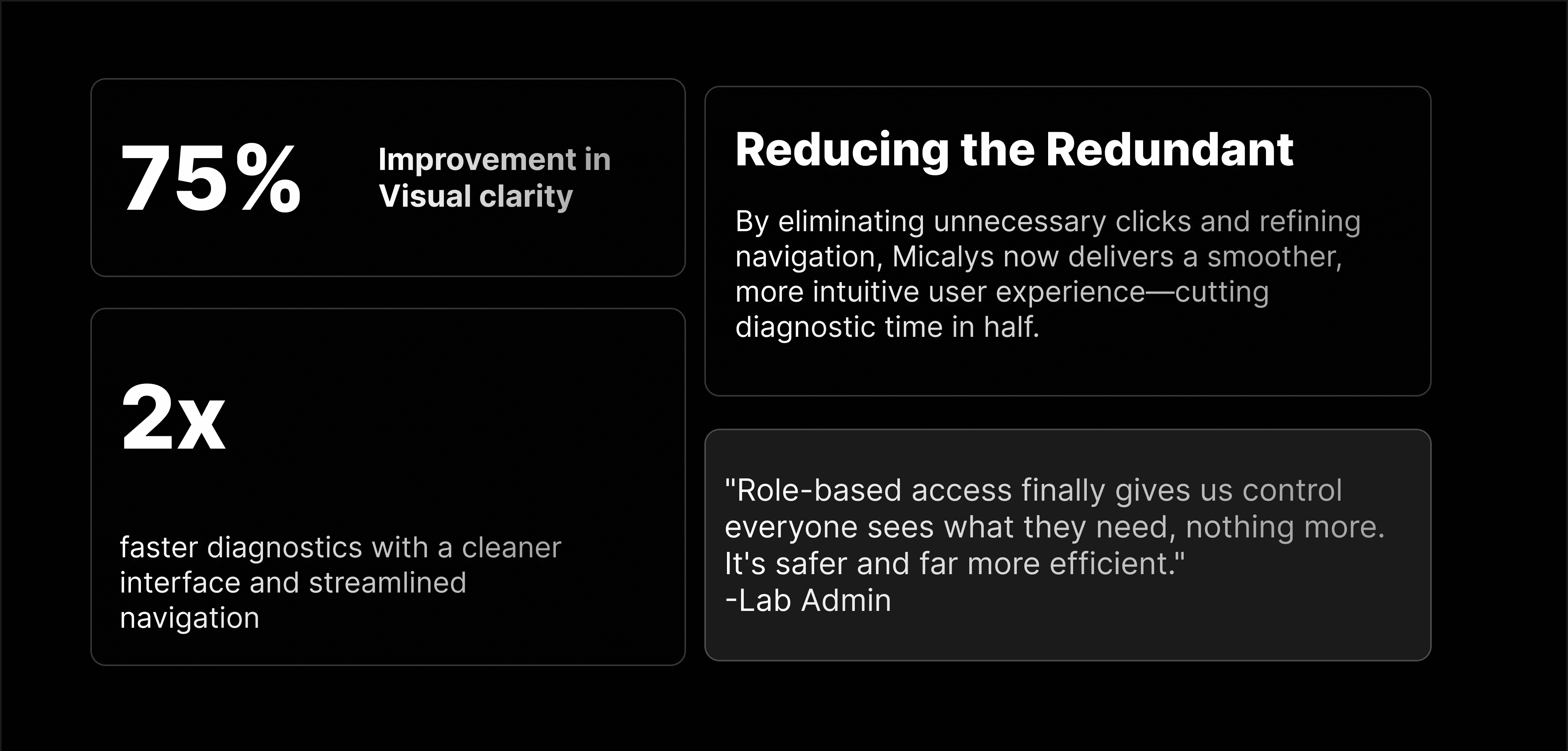
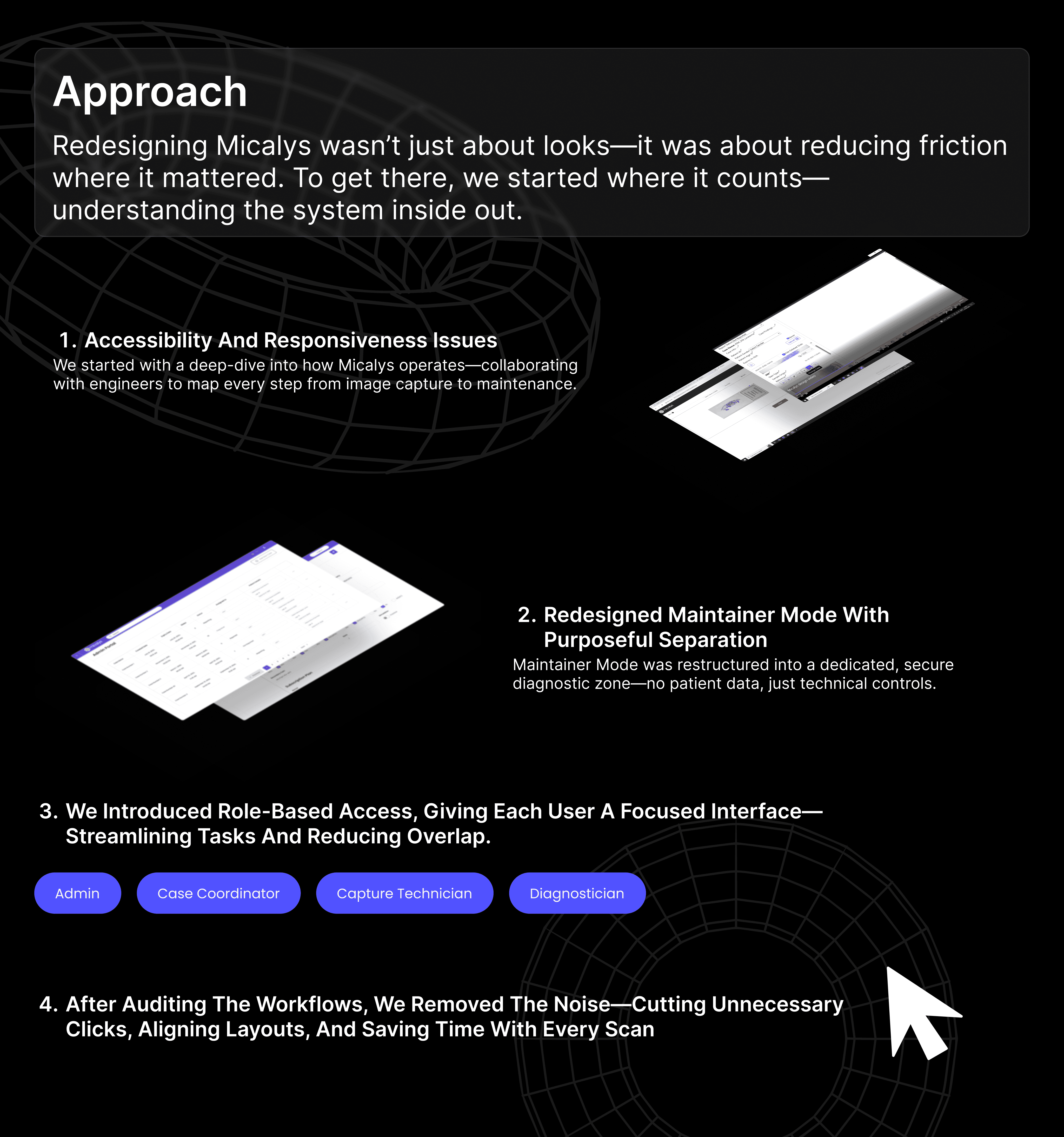
I led a full interface redesign grounded in real-world device behaviour and user roles. The redesigned system reduced unnecessary clicks, introduced layout consistency, and created clear, role-based access to streamline workflows. I restructured the Maintainer Mode to function independently from the diagnostic interface, limiting it to technical tools like device logs and system health checks, while removing access to patient slides to prevent data breaches. By mapping user journeys and responsibilities, I ensured each role had a focused, intuitive experience.
I led a full interface redesign grounded in real-world device behaviour and user roles. The redesigned system reduced unnecessary clicks, introduced layout consistency, and created clear, role-based access to streamline workflows. I restructured the Maintainer Mode to function independently from the diagnostic interface, limiting it to technical tools like device logs and system health checks, while removing access to patient slides to prevent data breaches. By mapping user journeys and responsibilities, I ensured each role had a focused, intuitive experience.
I led a full interface redesign grounded in real-world device behaviour and user roles. The redesigned system reduced unnecessary clicks, introduced layout consistency, and created clear, role-based access to streamline workflows. I restructured the Maintainer Mode to function independently from the diagnostic interface, limiting it to technical tools like device logs and system health checks, while removing access to patient slides to prevent data breaches. By mapping user journeys and responsibilities, I ensured each role had a focused, intuitive experience.
I led a full interface redesign grounded in real-world device behaviour and user roles. The redesigned system reduced unnecessary clicks, introduced layout consistency, and created clear, role-based access to streamline workflows. I restructured the Maintainer Mode to function independently from the diagnostic interface, limiting it to technical tools like device logs and system health checks, while removing access to patient slides to prevent data breaches. By mapping user journeys and responsibilities, I ensured each role had a focused, intuitive experience.
SOLUTION
I led a full interface redesign grounded in real-world device behaviour and user roles. The redesigned system reduced unnecessary clicks, introduced layout consistency, and created clear, role-based access to streamline workflows. I restructured the Maintainer Mode to function independently from the diagnostic interface, limiting it to technical tools like device logs and system health checks, while removing access to patient slides to prevent data breaches. By mapping user journeys and responsibilities, I ensured each role had a focused, intuitive experience.

WHAT HAVE WE ACHIEVED
WHAT HAVE WE ACHIEVED
I led a full interface redesign grounded in real-world device behaviour and user roles. The redesigned system reduced unnecessary clicks, introduced layout consistency, and created clear, role-based access to streamline workflows. I restructured the Maintainer Mode to function independently from the diagnostic interface, limiting it to technical tools like device logs and system health checks, while removing access to patient slides to prevent data breaches. By mapping user journeys and responsibilities, I ensured each role had a focused, intuitive experience.
LEARNINGS
I led a full interface redesign grounded in real-world device behaviour and user roles. The redesigned system reduced unnecessary clicks, introduced layout consistency, and created clear, role-based access to streamline workflows. I restructured the Maintainer Mode to function independently from the diagnostic interface, limiting it to technical tools like device logs and system health checks, while removing access to patient slides to prevent data breaches. By mapping user journeys and responsibilities, I ensured each role had a focused, intuitive experience.
Security must be built into the UX
The Maintainer Mode redesign taught me that privacy and security aren’t just back-end concerns they start with intentional interface design and access control.
Small interface changes can solve big problems
Even minor adjustments in layout, click paths, or access permissions can drastically improve efficiency, prevent misuse, and build user trust.
Hardware-aware design strengthens usability
Working with a physical medical device reminded me that good UX must also account for hardware behavior, limitations, and context of use.
Security must be built into the UX
The Maintainer Mode redesign taught me that privacy and security aren’t just back-end concerns they start with intentional interface design and access control.
Security must be built into the UX
The Maintainer Mode redesign taught me that privacy and security aren’t just back-end concerns they start with intentional interface design and access control.
Small interface changes can solve big problems
Even minor adjustments in layout, click paths, or access permissions can drastically improve efficiency, prevent misuse, and build user trust.
Small interface changes can solve big problems
Even minor adjustments in layout, click paths, or access permissions can drastically improve efficiency, prevent misuse, and build user trust.
Hardware-aware design strengthens usability
Working with a physical medical device reminded me that good UX must also account for hardware behavior, limitations, and context of use.
Hardware-aware design strengthens usability
Working with a physical medical device reminded me that good UX must also account for hardware behavior, limitations, and context of use.
LEARNINGS
I led a full interface redesign grounded in real-world device behaviour and user roles. The redesigned system reduced unnecessary clicks, introduced layout consistency, and created clear, role-based access to streamline workflows. I restructured the Maintainer Mode to function independently from the diagnostic interface, limiting it to technical tools like device logs and system health checks, while removing access to patient slides to prevent data breaches. By mapping user journeys and responsibilities, I ensured each role had a focused, intuitive experience.